
Yellostone microtopping
Microtopping worktops and kitchens
A kitchen in one material, without changing the units.
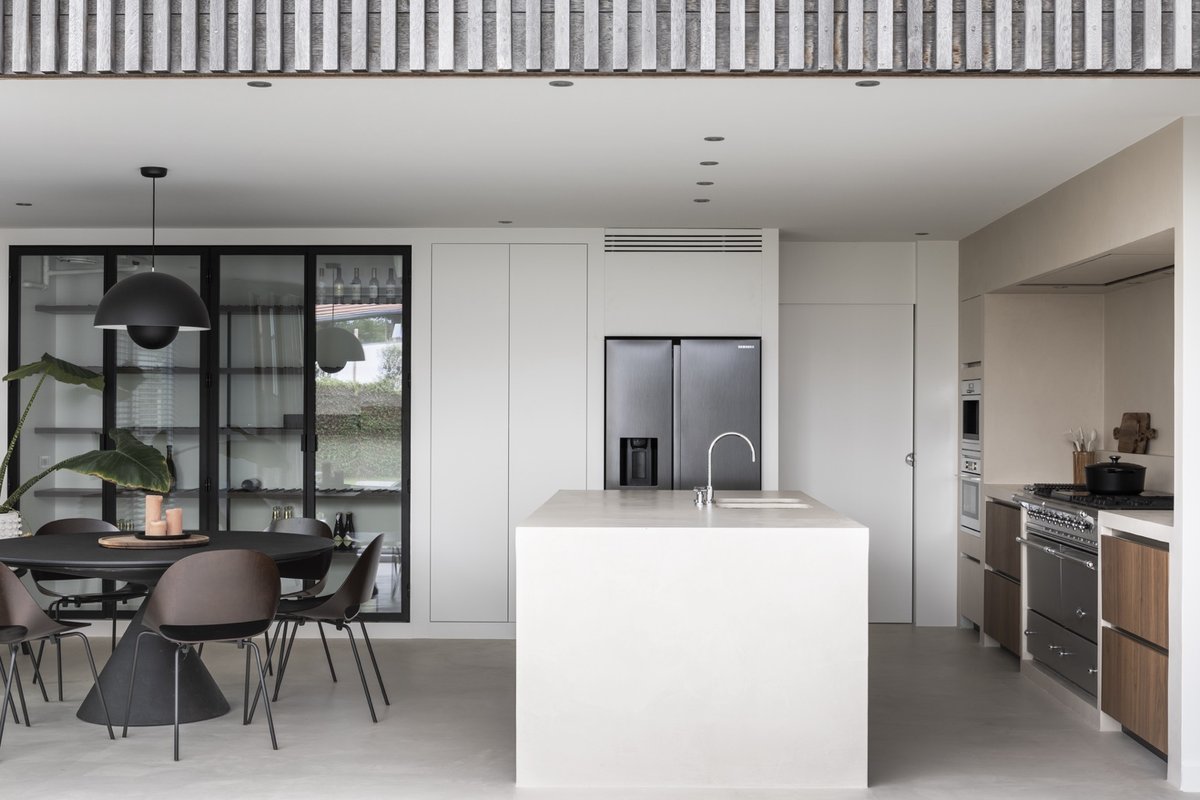
Microtopping covers the worktop, the splashback and the floor in the same shade, with no joints. At 2 to 3 mm, it goes over your existing worktop: nothing to remove, and the units and appliances stay where they are.
Which worktops can you cover?
With the bonding primer, microtopping bonds to almost any substrate: an existing worktop, a painted surface, a wood-based panel, old tiles.
- Wood-based panel: it must be stable, screwed and glued.
- Solid wood: avoid it. It moves with humidity, and the coating would follow its movements.
- Tiled worktop: the grout lines are filled first with a skim to zero, or they show through. See our page on microtopping over tiles.
Your stockist can tell you the right preparation for your worktop.
Made for everyday use
- Two coats of varnish, matt or satin at the same price, protect against stains and moisture.
- Cement-free, it does not crack, unlike most microcement.
- Cleaning: water and a mild soap; avoid harsh products.
As with any worktop, use a chopping board and a trivet.
How much microtopping for a worktop?
Yellostone microtopping is sold by the m², in 5 m² kits. A worktop 3 m long and 65 cm deep is about 2 m². Add the edges and, if you are redoing it too, a 60 cm high splashback along the same length, about 1.8 m². One 5 m² kit covers the lot.
Application in brief
The worktop is sanded and dusted, then covered with primer, three coats of microtopping and two coats of varnish. Allow 4 to 5 days on site and 7 days before normal use. A careful DIYer can do it; to get your hand in, we run training courses.
Which colour for a kitchen?
Every shade in the colour chart works, at the same price per m². To get you started: grey microtopping, beige and white. Before you decide, lay a 30 × 30 cm sample on your current worktop: kitchen light changes the way a shade looks a great deal.
Kitchen projects
- Modern kitchen and dining room, in Bruges: island and splashback.
- Microtopping kitchen: worktop.
What surfaces can microtopping go on?
| Substrate | Application | Main condition |
|---|---|---|
| Cement screed or slab | Suitable | Sound, dry, stable and prepared substrate |
| Underfloor heating | Suitable, following the protocol | Heating run beforehand, stability, movement joints respected |
| Existing tiles | Possible after inspection | Adhesion, stability, sanding and the right primer |
| Plasterboard on walls | Suitable | Rigid boards, treated joints and preparation |
| Wood or wood-based panels | Suitable except solid wood | Dimensional stability and sound assembly (screwed and glued) |
| Terracotta or damp substrate | Not recommended on substrates soaked deep with old oil or wax. Max. moisture 5% | Surface and moisture check required beforehand |
Frequently asked questions
Can you cover an existing kitchen worktop?
Yes. With the bonding primer, microtopping goes over the worktop in place, without replacing it. Your stockist can tell you the right preparation.
Can microtopping go on a wooden worktop?
On a stable panel, screwed and glued, yes. On solid wood, no: it moves with humidity.
Can it go over a tiled worktop?
Yes, once the grout lines are filled with a skim to zero. See our page on microtopping over tiles.
Can you put a hot pan on a microtopping worktop?
Always use a trivet.
How much microtopping do I need for a worktop?
Add up the worktop, its edges and the splashback: a 3 m worktop with its splashback is about 4 m², so one 5 m² kit.